Model: Google AI Overview · Google Search
Google has confirmed its anti-spam rules apply to AI-generated answers in Search. The clarification quietly resets the rules of the AI visibility game for every brand that appears - or wants to appear - inside Google's AI Overviews and AI Mode.
Source: Google Search Central - 15 May 2026 update
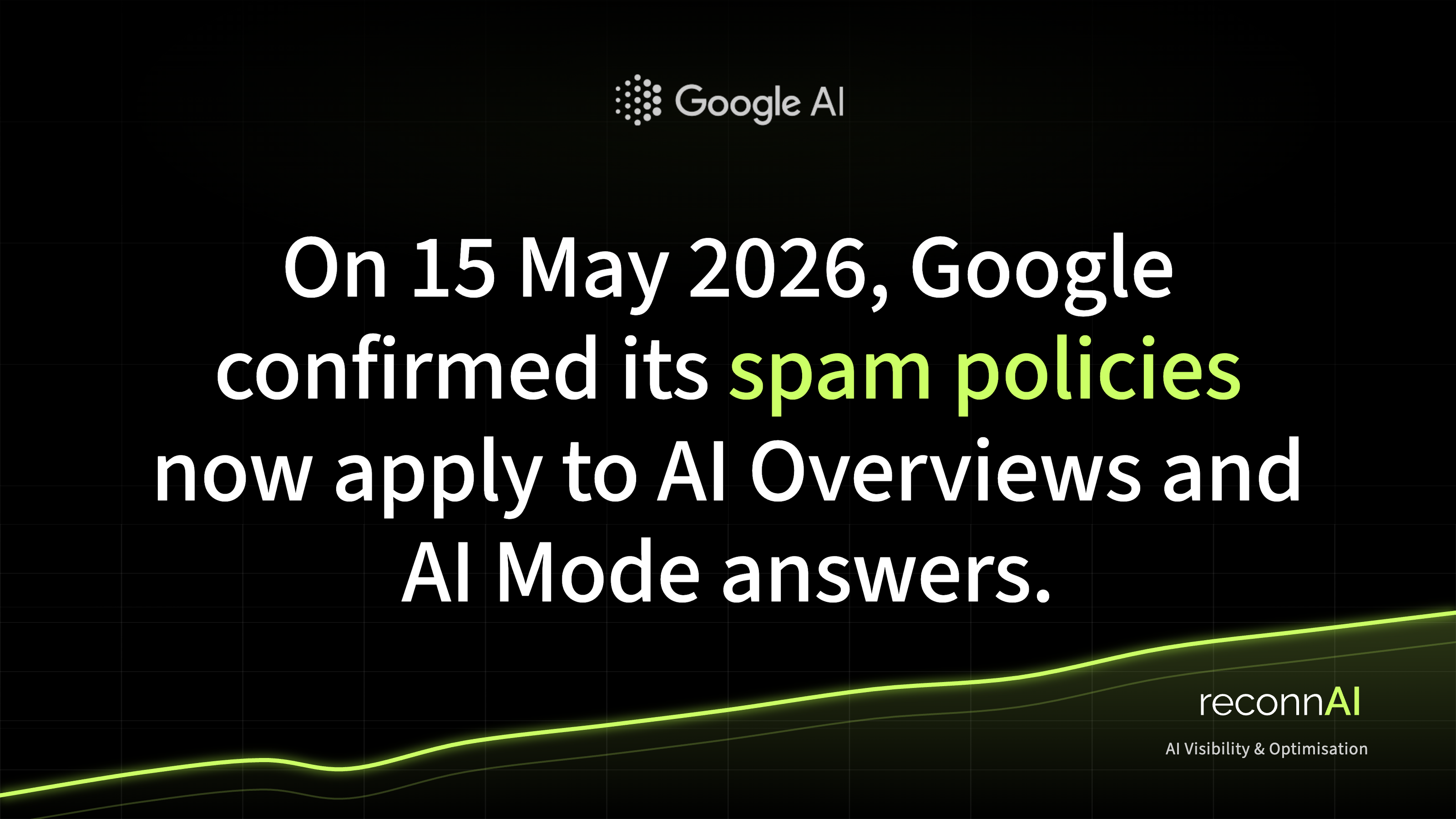
On 15 May 2026, Google updated its Search Central documentation to make something explicit that the market had been treating as ambiguous: the Google Search spam policies apply to AI-generated responses in Search, not just to the classic blue links. AI Overviews, AI Mode and any other generative surface inside Google Search are now formally inside the same anti-spam perimeter as the rest of the index.
It looks like housekeeping. It is not. For anyone tracking how Google's AI is talking about their brand, this is one of the most consequential policy clarifications of the year. It changes what is allowed to influence an AI answer, what Google is willing to suppress, and which competitive tactics quietly stop working.
What Google actually clarified on 15 May 2026
The change is small in words and large in scope. Google's update note states that the Search spam policies also apply to generative AI responses in Google Search, and that those policies cover all of Google Search - including the AI surfaces. There is no new rulebook. The existing spam policies have simply been extended, on the record, to the generative answer.
That existing rulebook already covers a broad range of behaviours: scaled content abuse, site reputation abuse, cloaking, sneaky redirects, expired-domain abuse, link spam, machine-generated text designed to manipulate ranking, hidden text and links, keyword stuffing, deceptive structured data, and thin or low-value content. As of 15 May 2026, every one of those behaviours is now formally a basis for action against AI-generated responses too.
Put plainly: a tactic that would get a page demoted in the ten blue links can now get a brand suppressed inside an AI Overview, an AI Mode answer, or any other generative response Google ships next.
Why this is a turning point for AI visibility
Until this clarification, a quietly held assumption in parts of the SEO and AI-search world was that AI surfaces were a separate game - that AI Overviews drew from a different signal stack and therefore sat outside traditional spam enforcement. Some brands and agencies were already testing the edges: aggressive site reputation abuse, scaled AI-generated comparison pages, fake review networks pointed at generative surfaces, and content engineered specifically to be quoted inside an AI answer.
Google has now closed that gap on paper. Three implications matter for AI visibility tracking.
1. AI Overview visibility is now contestable on policy grounds
If a competitor is appearing in AI Overviews on the back of scaled thin content, expired-domain hijacks, fake reviews or coordinated link spam, that visibility is now exposed to the same enforcement that would hit them in classic Search. Manual actions, algorithmic suppression and the broader spam-update cycle apply to the AI answer, not just to the ranked links that sit below it.
Brands tracking their share of voice in Google's AI surfaces should expect to see some of these competitors lose AI presence over the coming weeks and months. The next confirmed spam update is likely to be the first visible test.
2. The risk profile of AI-only optimisation just changed
Tactics built specifically to game generative answers - mass AI-spun comparison pages, programmatically generated "best of" listings, prompt-targeted doorway content, manipulated structured data designed to be lifted verbatim into an AI summary - are now squarely inside Google's spam-policy perimeter. Anything that would have been called scaled content abuse, sneaky redirects or deceptive structured data on a classic results page is the same violation when it shows up inside an AI Overview.
For brands evaluating AI visibility vendors, agencies or in-house tactics, this is a useful filter. Anything that relies on tricking the generative layer rather than improving the underlying evidence base now carries the same downside as classic black-hat SEO: not just diminishing returns, but active suppression.
3. The honest baseline gets a quiet lift
Every time Google tightens enforcement, brands that have been competing on real product evidence, genuine reviews and clean editorial coverage get a small, structural boost. The clarification on 15 May 2026 is no different. As manipulated AI visibility is squeezed out of AI Overviews and AI Mode, the slots have to be filled by something - and that something is the trustworthy, retrievable signal that the model can actually defend.
Smaller and mid-market brands with strong real-world reputation, but limited budget to chase aggressive tactics, are likely to be the largest single beneficiaries. The visibility gap between honest brands and high-volume manipulators should narrow rather than widen over the next two quarters.
Tactics that are now explicitly off the table for AI visibility
Google's clarification does not introduce new prohibitions - it confirms existing ones cover AI surfaces. The practical list of tactics that are now clearly inside the spam perimeter, regardless of whether the goal is classic ranking or AI inclusion, includes:
- Scaled content abuse. Programmatically generated articles, comparison pages, "best of" lists and category hubs produced at scale with the primary purpose of being lifted into AI answers.
- Site reputation abuse. Renting or repurposing the authority of a trusted domain to host third-party content engineered to appear in Google's AI surfaces.
- Cloaking and sneaky redirects. Showing one version of a page to Googlebot and another to users, or routing AI-citation traffic to content that does not match what was indexed.
- Deceptive structured data. Marking up content with schema that misrepresents the underlying page in order to be quoted, cited or summarised inside an AI Overview.
- Fake or manipulated reviews and trust signals. Coordinated fake reviews, paid-for ratings and synthetic third-party endorsements that exist mainly to influence which brands the model recommends.
- Link spam and expired-domain abuse. Manufactured link networks, PBNs and expired-domain hijacks that aim to feed a brand into AI Overviews via inflated authority signals.
- Hidden text, keyword stuffing and AI-targeted doorway pages. Content engineered to be invisible to users but readable by the model, designed to bias which brand it surfaces.
If any of these are inside a current AI visibility programme - either yours or a competitor's - they should be treated as policy risk from 15 May 2026 onwards, not just as tactical risk.
What to track in the first 30 days under the new clarification
A policy clarification of this scope rarely shows up as a single, dated movement on a dashboard. It shows up as a quiet reshuffling of who appears in Google's AI answers over the following weeks - particularly around the next confirmed spam or core update. Five things are worth measuring deliberately:
- Your AI Overview presence rate. Track the share of your tracked prompts that surface your brand inside an AI Overview, week over week, against the 15 May baseline.
- Competitor churn inside AI Overviews. Watch for competitors with thin, scaled or low-trust content profiles disappearing from AI answers. New names appearing in their place is a leading indicator of where Google is reweighting trust signals.
- Citation sources next to your brand. Which domains is Google's AI now citing alongside your brand? A shift from low-trust scrapers and content farms toward established editorial, official directories and primary sources is the policy clarification doing its job.
- Brand mention quality, not just quantity. Tone, accuracy and the framing of your brand inside AI Overviews matter more than raw mention count. A higher-quality mention from a trustworthy source under the new policy is worth more than three mentions from sources Google is about to suppress.
- The classic-Search to AI-Search delta. Where your brand appears strongly in classic Search but not in AI Overviews - or vice versa - is now a useful diagnostic. Under the harmonised policy, large persistent gaps are increasingly explainable by either content quality or signal trust, not by the AI surface being a different game.
How reconnAI is covering the change
reconnAI tracks how Google AI Overview, ChatGPT, Gemini, Perplexity and Copilot represent your brand across regions - including the citation domains, competitor co-occurrence and tonal framing inside each AI answer. The 15 May 2026 clarification is being treated as a policy event in our Google AI Overview tracking: the underlying brand-visibility timeseries continues, but readings from 15 May onwards sit inside a tightened enforcement regime that should compress manipulative visibility and reward trustworthy signal.
If your brand operates in a category where Google AI Overview is load-bearing - finance, health, legal, B2B SaaS, travel, retail or anything with a heavy comparison-shopping behaviour - this is the moment to confirm that your AI visibility is being built on signals Google's new perimeter will protect rather than punish.
Track how Google AI is talking about your brand under the new policy
If you want to see how Google AI Overview, ChatGPT, Gemini and Perplexity are representing your brand week over week - and how the 15 May 2026 spam-policy clarification is reshaping that picture in your category - reconnAI's AI Visibility Tracking platform was built for exactly this kind of moment.
To map how the harmonised spam policy is likely to reshape your AI visibility specifically, and to identify any tactics in your own or your competitors' programmes that now carry policy risk, get in touch with our team. We will help you re-baseline against Google's new AI perimeter before the next spam update bakes in the new winners and losers.
About reconnAI
reconnAI tracks how your brand appears across ChatGPT, Claude, Gemini, Perplexity, Copilot and Google AI Overview - across multiple regions. We monitor mentions, citations, competitor positioning and tone shifts so you can understand and optimise your AI visibility before it impacts your pipeline.