Model: Google Search & AI Overviews
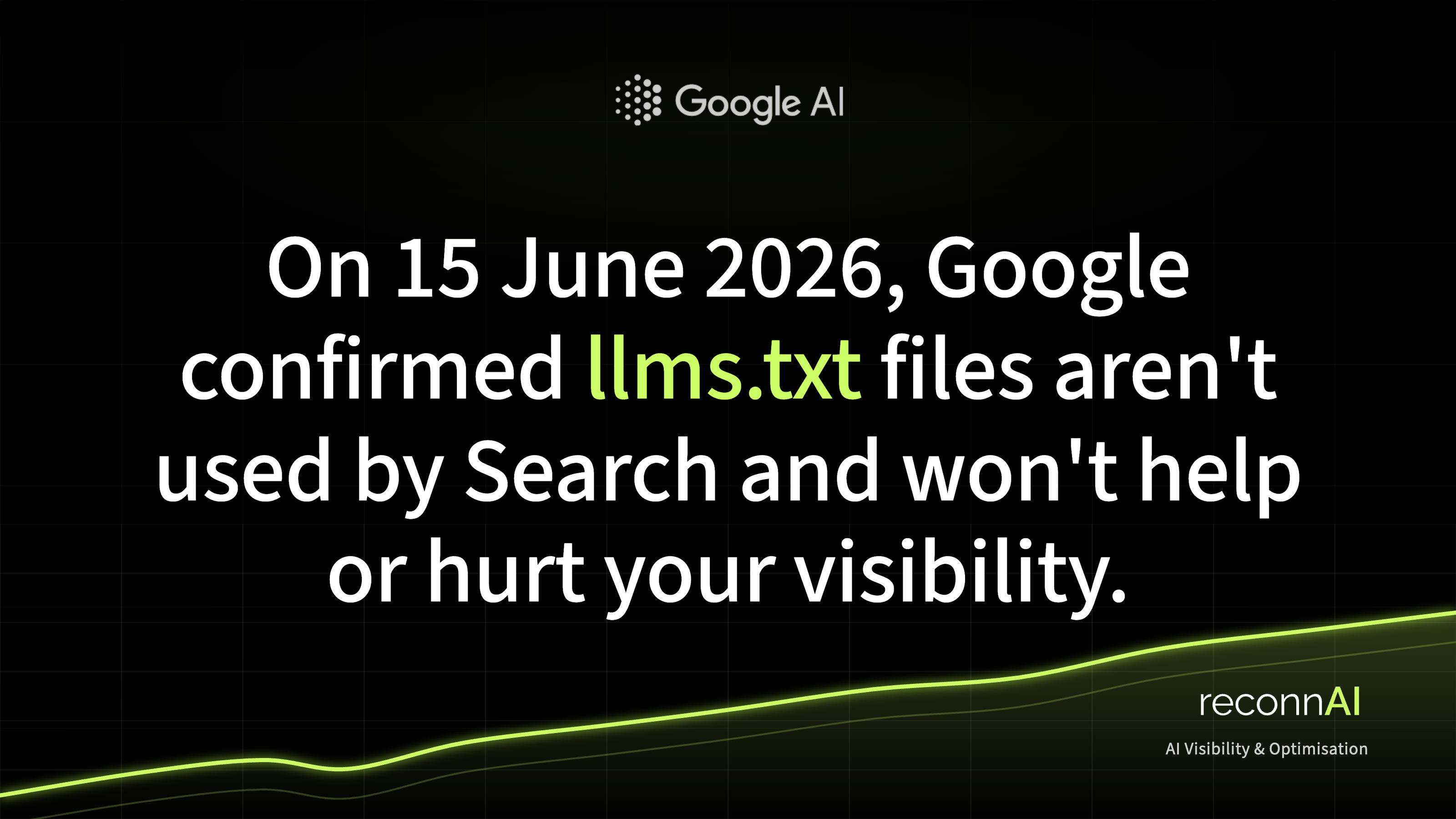
On 15 June 2026, Google updated its AI optimization guide to clarify how Google Search treats llms.txt files — confirming that these files aren’t needed for Search and won’t positively or negatively affect your visibility or rankings. For anyone investing in AI discoverability, it’s a useful line in the sand about what actually moves the needle.
llms.txt has become one of the most talked-about ideas in the GEO and AI-search community over the past year. Google’s clarification doesn’t kill the format — but it does tell brands exactly where it does, and doesn’t, belong in an AI visibility strategy.
What Google actually said
Google added a note to its AI optimization guide to address a steady stream of community questions. The clarification makes three things clear:
Google Search doesn’t need llms.txt. The file is not part of how Google crawls, indexes or summarises your site.
It has no ranking effect — in either direction. Maintaining an llms.txt file won’t boost your visibility, and not having one won’t hurt it.
You can keep it for other systems. If other tools or AI services in your stack consume llms.txt, it’s perfectly fine to maintain one — Google simply won’t read it.
What is llms.txt — and why the confusion?
llms.txt is a proposed plain-text file you place at the root of your domain, designed to give large language models a clean, curated map of your most important content — a sort of robots.txt for the AI era. The idea is appealing: rather than leaving an AI model to crawl a messy site, you hand it a tidy summary of what matters.
The confusion has come from treating llms.txt as a universal lever. Because it sounds like it should influence every AI system, many teams assumed maintaining one would improve how they appear in Google’s AI Overviews and AI Mode. Google has now confirmed that isn’t the case — its AI surfaces draw on the same index and signals as ordinary Search, not a separate llms.txt feed.
llms.txt & Google Search: assumption vs reality
Does Google Search need an llms.txt file?
Will it change your rankings or AI Overview visibility?
Should you keep a file you already have?
Source: Google Search Central — Clarifying guidance on llms.txt files, 15 June 2026.
Why this matters for your AI visibility
The temptation in a fast-moving space is to chase every new file, tag and standard. Google’s clarification is a reminder that effort spent on a format one major platform ignores is effort not spent on the things that genuinely shape whether your brand gets cited.
It also underlines an important nuance: the AI search landscape is not monolithic. An llms.txt file may still be read by certain crawlers and tools, but Google — one of the largest AI answer surfaces through AI Overviews and AI Mode — does not use it. Knowing which platform responds to which signal is the difference between a strategy built on evidence and one built on hope.
Where AI discoverability actually comes from
If llms.txt isn’t the lever for Google, what is? The same fundamentals that drive citations across ChatGPT, Gemini, Perplexity and Copilot:
Clear, well-structured content that answers real questions directly, so a model can lift an accurate summary.
Strong third-party coverage — the reviews, listicles and authoritative mentions that AI models lean on as evidence when deciding which brands to name.
Crawlable, indexable pages using standards Google does honour, so your content is actually available to the systems behind AI answers.
Consistent entity signals — a coherent picture of who you are and what you do across the web, so models associate the right products and claims with your brand.
How reconnAI helps you track it
The only reliable way to know whether a tactic is working is to measure the outcome — how often, and how favourably, your brand appears in real AI answers. reconnAI monitors brand mentions, citation sources, competitor positioning and sentiment across every major AI surface, so you can see whether changes to your content and coverage actually move your presence in Google’s AI Overviews, AI Mode and the wider LLM ecosystem.
Rather than guessing whether the latest file or format helps, you get an evidence base for where to spend your effort. You can get in touch with our team for a walkthrough of your current AI visibility, or head to reconnAI’s AI tracking platform to see how your brand is showing up across the models that matter.
About reconnAI
reconnAI tracks how your brand appears across ChatGPT, Claude, Gemini, Perplexity, Copilot and Google AI Overview — across multiple regions. We monitor mentions, citations, competitor positioning and tone shifts so you can understand and optimise your AI visibility before it impacts your pipeline.